
AI cold calling done right: reactivate your own customer base
AI cold calling without the spam: how to reactivate your own old customer base and leads lawfully with an AI voice agent — consent, opt-outs, speed to lead.

AI cold calling usually conjures up a robot dialling thousands of strangers. That isn't what we do, and in Europe, the UK and the US it would mostly be unlawful anyway. When we talk about “cold” calling with AI, we mean something more useful: reactivating your own old customer base — past customers and leads who once gave you their details, haven't heard from you in a long time, and may not even remember your name. That database is often a company's most underused asset. An AI voice agent can work through it politely and at scale, but only within clear legal limits.
This guide explains what database reactivation with AI looks like, the rules in Spain (where we operate), the UK and the US, a lawful step-by-step funnel, how to write the call, and how speed to lead fits in.
This article is for information only and is not legal advice. Check every list and campaign with your adviser or data protection officer.
What “cold” means here — and what it doesn't
| “Cold” as we use it | Not what we mean |
|---|---|
| Past customers who stopped buying | Bought or rented contact lists |
| Leads who asked for a quote and went quiet | Numbers scraped from websites or directories |
| Contacts who opted in to hear from you, long ago | Randomly generated numbers |
| New enquiries waiting to be called back | Anyone on an opt-out register without consent |
The difference is not cosmetic. With your own base you know where each contact came from, what they bought and what they agreed to — which is exactly what you need to decide whether a call is lawful.
The legal reality, briefly
Spain. Article 66.1 of the General Telecommunications Act (Law 11/2022) gives people the right (a) not to receive automated calls without human intervention for marketing without prior consent, and (b) not to receive unwanted marketing calls unless they consented or another GDPR legal basis applies. The data protection authority (AEPD) states that automated marketing calls without human intervention are not allowed without prior consent. An AI voice agent holds a real conversation, but no person is on the line — so the cautious reading is that AI marketing calls need prior consent.
The AEPD's Circular 1/2023 accepts legitimate interest only in narrow cases: existing customers, products similar to what they bought, and an interaction within the last year. An old base that “doesn't remember you” usually fails that last test. Add three more obligations: check opt-out registers such as the Lista Robinson; from 17 October 2026, companies within the scope of Law 10/2025 must place marketing calls only from 400 numbers (see our guide to the 400 prefix); and the agent must say it's an AI (Article 50 of the EU AI Act, applicable from 2 August 2026).
UK. Under PECR, the ICO says automated marketing calls need the person's specific consent to that type of call; live calls must be screened against the TPS. The cautious assumption is that an AI-voiced call is treated as automated.
US. In February 2024 the FCC confirmed that AI-generated voices count as “artificial” voices under the TCPA, so calls using them need the called party's prior express consent — and for telemarketing, prior express written consent — plus identification and an opt-out.
The common thread: for AI marketing calls to an old base, plan on consent. Legitimate interest is a narrow exception, not a strategy.
A lawful reactivation funnel
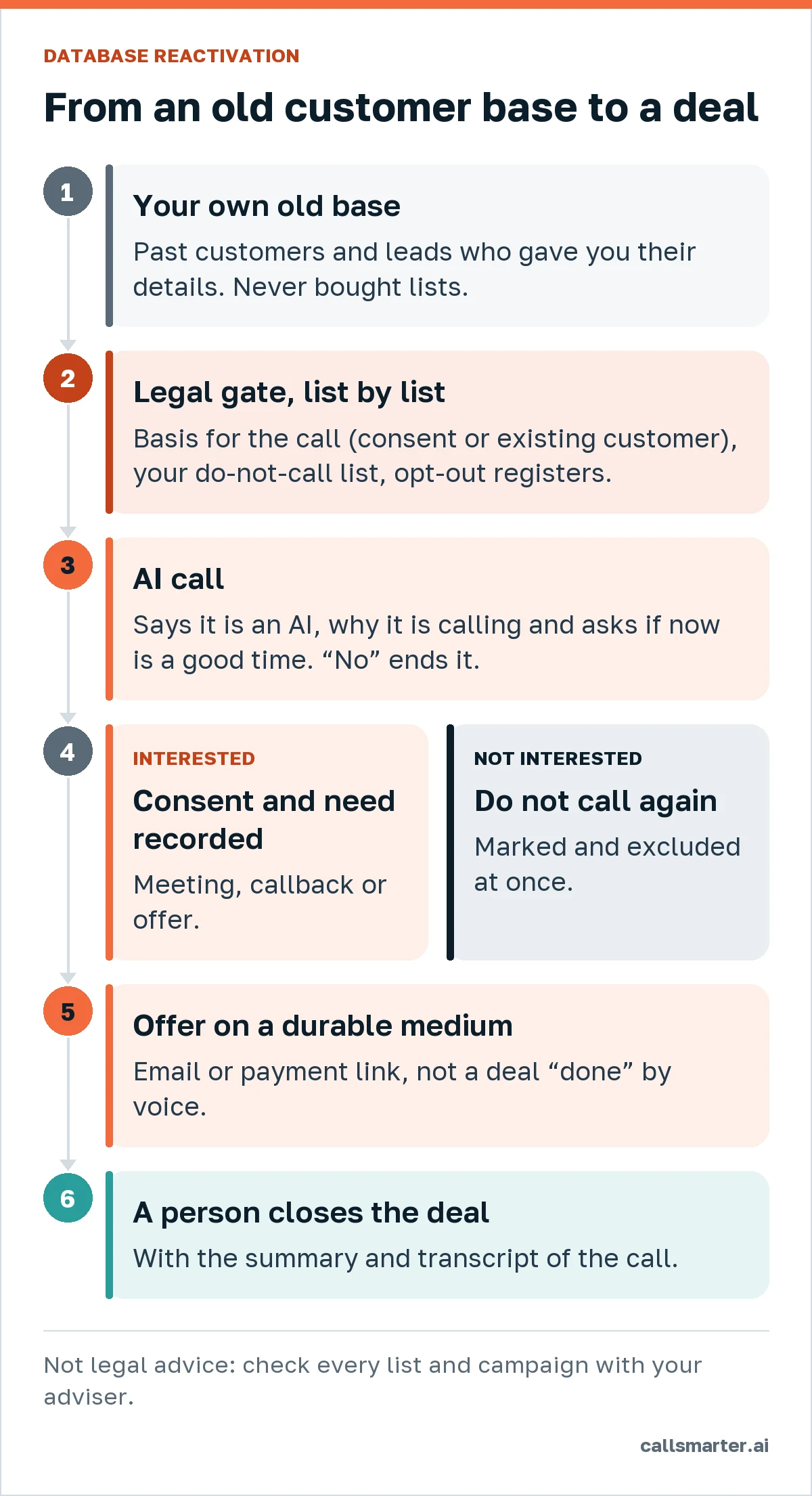
- Start from your own base. Export past customers and leads with their source, last purchase or interaction, and any consent records.
- Legal gate, list by list. Split the base by basis: contacts who consented to calls; existing customers with a recent relationship; everyone else. Remove anyone on your own do-not-call list and, for marketing, check opt-out registers. On CallSmarter you can't upload a calling list without declaring its legal basis and confirming it.
- Get permission where you don't have it. For contacts without consent to calls, use a channel you can use. In Spain, Article 21.2 of the LSSI allows commercial emails to people with a prior contract, about your own products similar to what they bought, provided the data was obtained lawfully and every email offers an easy opt-out — such an email about a similar product can include an invitation to request a call. A web form or a reply is their consent, recorded with time and text.
- The AI call. The agent says it's an AI and who it's calling for, explains why in one sentence and asks if it's a good time. A “no” ends the call politely.
- Record the outcome. Interested → consent and need recorded, meeting or callback booked. Not interested → marked do-not-call, excluded everywhere.
- Offer on a durable medium. Email, a written proposal or a payment link — not a deal “done” by voice.
- A person closes. With the call summary and transcript in the CRM.
How to write the call
- First sentence: who and what. “Hello, I'm the AI assistant calling on behalf of Garcia Air Conditioning. This call is recorded.”
- Second: why you, why now. “You had your unit installed with us in 2023, and we're calling customers about the service before summer.”
- Ask permission. “Is now a good moment, or shall I leave it?”
- One question at a time, no pressure, no fake urgency, no invented discounts.
- Opt-out in one word. “No”, “stop”, “don't call me” → “Understood, we won't call you again. Have a good day.”
- No prices or terms the agent can't guarantee. It offers a written offer or a call from a person.
Our general guide to AI outbound calls in Spain covers service calls such as appointment confirmations, which follow different rules from marketing.
Speed to lead: the warmest calls are the new ones
The other half of “AI cold calling” is not cold at all: calling new enquiries fast. Someone fills in your form asking to be called — that is their request — and every hour you wait, the lead cools. A widely cited Harvard Business Review study audited 2,241 US companies: those that tried to contact a lead within an hour were nearly seven times as likely to qualify it as those that waited longer, and more than 60 times as likely as those that waited 24 hours or more. It's an older study, but your own data will likely tell the same story.
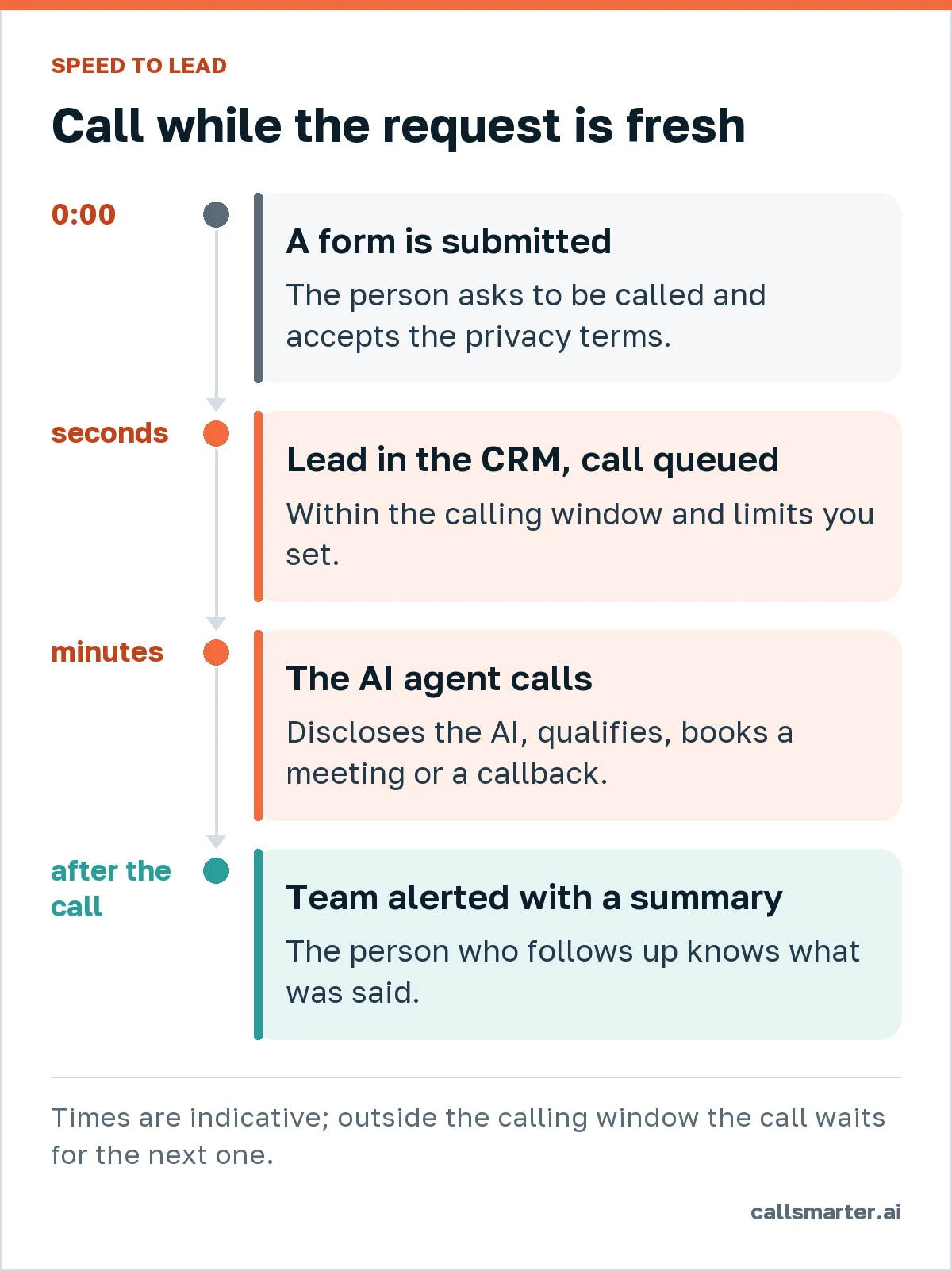
With an AI agent, the call can go out within minutes, inside the calling hours you set, and your team gets the summary when it ends. That's how we sell CallSmarter ourselves: see CallSmarter on CallSmarter and our write-up on our own AI funnel.
How CallSmarter keeps reactivation clean
- Legal basis per list. Consent, existing-customer contract, legitimate interest for existing customers, or other — declared and confirmed before any campaign can start.
- AI disclosure built in. The platform adds it to every outbound call; a script can't remove it.
- Do-not-call in one place. A “no” on a call marks the contact and excludes it from all campaigns.
- Frequency caps. Limits on how often the same number is called across campaigns.
- Calling windows in each contact's time zone, retries and budget limits that pause the campaign by themselves.
- 400 caller IDs. Commercial campaigns to Spanish numbers can be tied to lines with a 400 number.
- Everything recorded. Recording, transcript, summary and a 0–100 quality score for every call.
What to measure
No conversion promises — measure: contact rate, completed conversations, opt-out rate (if it rises, the list or script is wrong), qualified contacts, meetings, and cost per result. A pilot of about four weeks and 500–1,000 calls is enough to know.
Want to hear how an AI reactivation call sounds? Let Foxy call you now — she'll tell you she's an AI before anything else. When you're ready, request a pilot and we'll review your lists, legal side included. More on the business case in voice AI for business.
Frequently asked questions
Is AI cold calling legal?
Calling strangers from bought lists or random numbers with an AI voice is, in practice, off the table in Spain, the UK and the US: automated or artificial-voice marketing calls generally need the person's prior consent. Calling your own customers and leads can be lawful when you have the right basis for that specific call — check each list with your adviser.
What do you mean by “cold” here?
Your own old base: past customers and leads who gave you their details at some point but haven't heard from you in a long time and may not remember you. Not purchased data.
Can I rely on legitimate interest instead of consent in Spain?
Only narrowly. The AEPD's Circular 1/2023 accepts legitimate interest for existing customers, for similar products, when there was an interaction in the last year. And automated calls without human intervention need prior consent under Article 66.1(a) of the Telecommunications Act. For an old base called by AI, plan on consent.
What happens if someone says no?
The agent stops, confirms they won't be called again, marks the contact as do-not-call and the platform excludes them from every campaign.
What is speed to lead?
Calling a new enquiry within minutes instead of hours. A Harvard Business Review study of 2,241 US companies found that firms contacting a lead within an hour were nearly seven times as likely to qualify it as those that waited longer.
Will the AI pretend to be a salesperson?
No. It says it's an AI in its first sentence, explains why it's calling and asks if it's a good time. Deals are closed by people, on a written offer.
Sources
- Spanish Law 11/2022, General Telecommunications Act, Article 66 (BOE)
- AEPD FAQ: automated calls without human intervention for marketing purposes
- AEPD: Circular 1/2023 on unsolicited marketing calls (press release)
- Spanish Law 34/2002 on information society services (LSSI), Article 21 (BOE)
- Resolution of 14 April 2026 on numbering for marketing calls, 400 range (BOE-A-2026-8409)
- Lista Robinson (Spanish advertising opt-out register)
- European Commission: transparency obligations under Article 50 of the AI Act
- FCC Declaratory Ruling FCC 24-17: AI-generated voices under the TCPA
- ICO: telephone marketing under PECR
- Harvard Business Review: The Short Life of Online Sales Leads (2011)