
Spain's 400 prefix for marketing calls: what changes on 17 October
Spain's 400 prefix: from 17 October 2026 marketing calls by companies under Law 10/2025 must come from 400 numbers. What the rule says and what to do.

From 17 October 2026, companies within the scope of Spain's customer service law (Law 10/2025) may only make marketing calls from numbers starting with 400. The rule comes from the Resolution of 14 April 2026 of the Secretary of State for Telecommunications and Digital Infrastructure (SETID), published in Spain's Official Gazette (BOE) on 16 April as BOE-A-2026-8409. A 400 number can only be used to place marketing calls: it can't receive calls and can't be used for customer service. The idea is simple — anyone in Spain who sees a 400 number on the screen knows it's a sales call before they answer.
This guide explains what the rule says, who it affects, the status of the industry's legal challenge, what to do before the deadline, and how it fits with calls made by AI voice agents. If you sell to consumers in Spain from abroad, it's worth reading too.
For information only, not legal advice. Status as of 7 October 2026; confirm your case with your adviser and your carrier.
Where the 400 prefix comes from
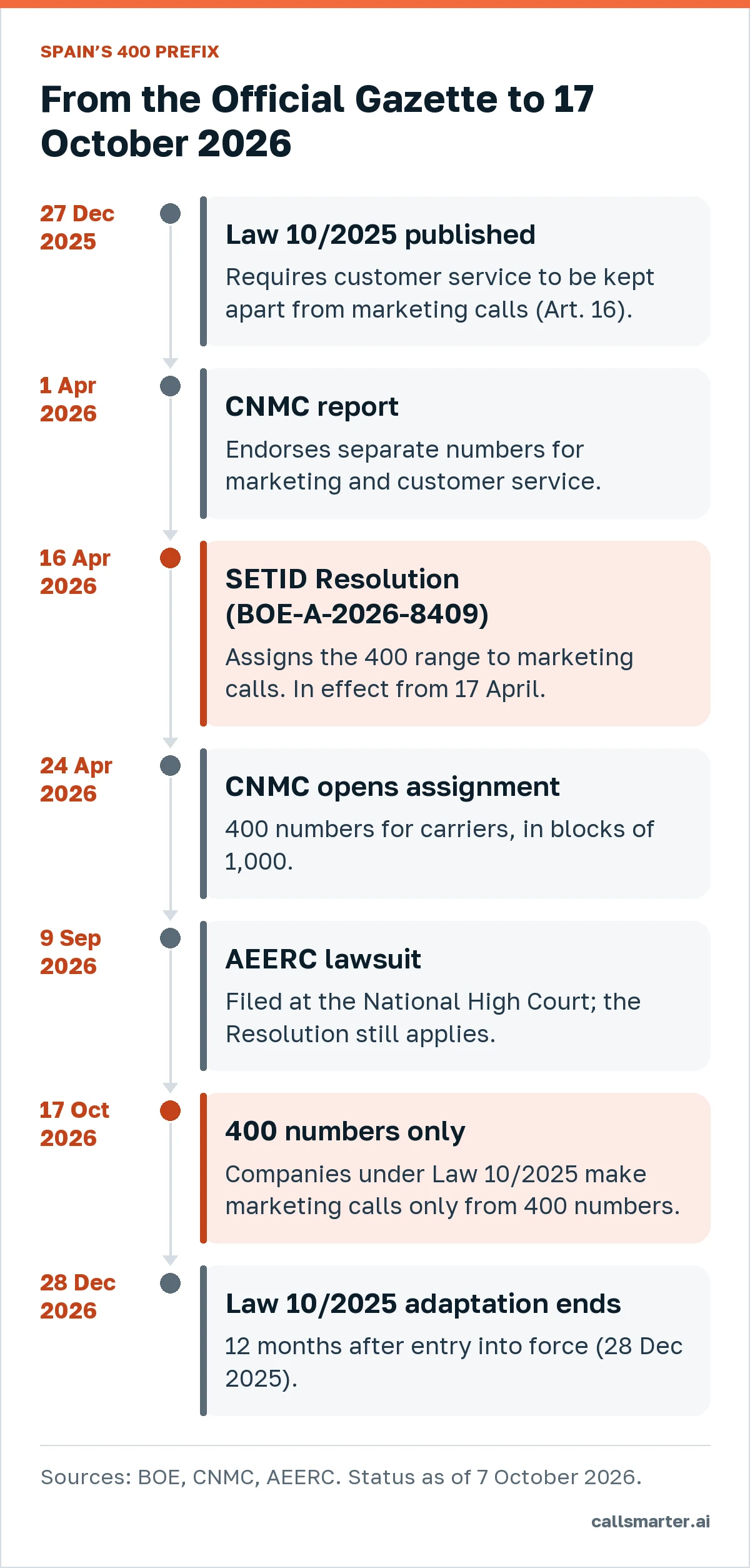
- Law 10/2025 of 26 December (BOE, 27 December 2025). Article 16 requires customer service to be clearly separated from a company's other activities and, on the phone, to use a specific numeric code distinct from the one used for marketing, which must itself be specific (Art. 16.3).
- CNMC report (1 April 2026). Spain's markets and competition regulator endorsed separating customer service numbers from marketing numbers and recommended extending the adaptation period from four to six months.
- SETID Resolution of 14 April 2026 (BOE, 16 April; in effect from 17 April). It assigns the 400 range to marketing calls:
- 400 numbers are origin-only for outbound marketing calls and can't receive incoming calls;
- they can't be used for customer service;
- calling a 400 number as a destination is prohibited;
- the range must be fully operational within six months, after which companies in scope may place marketing calls only from 400 numbers.
- CNMC assignment. On 24 April 2026 the BOE published the CNMC's announcement opening the initial assignment: only telephone carriers can request 400 numbers, in blocks of 1,000. Your 400 number therefore comes from your carrier.
The AEERC challenge
The Spanish Association of Customer Relationship Experts (AEERC) challenged the Resolution and, on 9 September 2026, filed its lawsuit at the administrative chamber of the National High Court (Audiencia Nacional). It argues, among other things, that SETID issued general rules without regulatory power, and that the measure treats spam the same as calls customers asked for. As of this article, the Resolution still applies and has not been suspended. Plan as if 17 October were final.
Who is affected
The obligation applies to companies within the scope of Law 10/2025. Under its Article 2 that means:
- every company providing basic services of general interest in Spain: water, gas and electricity; air, rail, sea and coach passenger transport; postal services; electronic communications; financial services;
- large companies and groups selling other goods or services to consumers, under the thresholds in Article 2.2 (broadly, 250 or more employees or set turnover and balance-sheet figures — check the exact text).
The law applies to companies established in Spain or in any other state that fall within that scope. If you outsource calls to a call centre, the obligation is still yours: the provider must use 400 numbers for your marketing campaigns.
Marketing call or customer service?
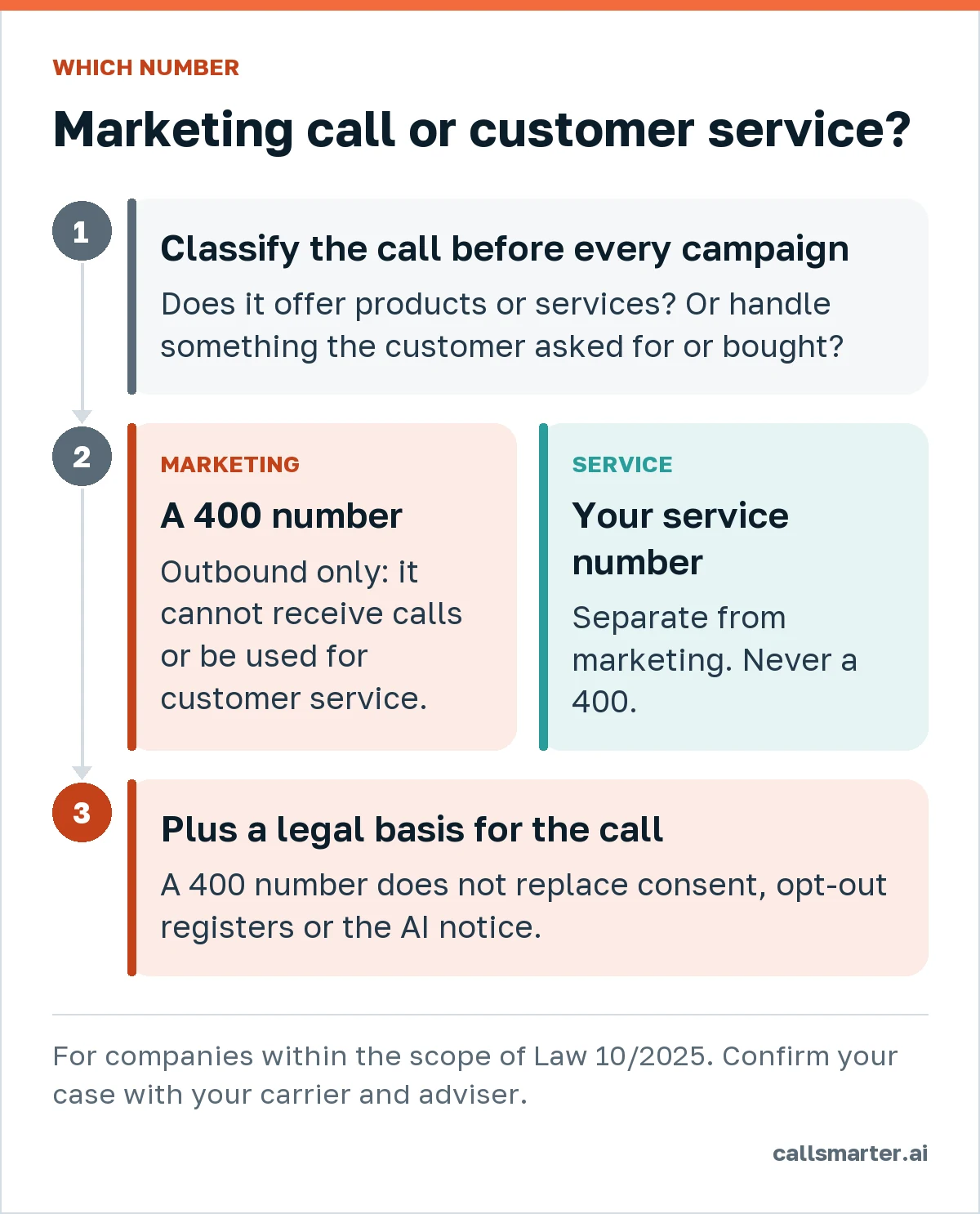
- Marketing: offering products or services, renewals on new terms, win-back promotions.
- Customer service: handling queries, complaints, claims or incidents, and managing what the customer already asked for or bought.
Beware of mixed calls. Law 10/2025 (Art. 16.2) bans using a complaint or incident about service continuity to make offers, unless the customer asks or the offer is linked to solving the problem and improves their terms. A service reminder with an offer attached is, in practice, a marketing call.
What happens if you don't comply
Article 16.4 of Law 10/2025 provides that the carrier originating or receiving the call shall block calls from numbers showing signs of making marketing calls without the specific numeric code, or without complying with Article 66.1 of the General Telecommunications Act (consent and other bases for marketing calls), using technical systems authorised by SETID. In practice, a marketing campaign from an ordinary landline or mobile number may simply not get through.
What to do before 17 October
- Inventory your outbound calls, their purpose and caller IDs — including outsourced providers.
- Classify each campaign in writing: marketing or customer service.
- Ask your carrier for 400 numbers for marketing; keep a separate number for customer service.
- Configure caller ID in your phone system, dialler, CRM and campaign tools — and test what the called person actually sees.
- Plan for call-backs. A 400 number can't receive calls, so tell customers during the call how to reach you.
- Check the legal basis of every list, the Lista Robinson opt-out register and your internal do-not-call list.
- Document it and train your team and providers.
The 400 prefix and AI voice agents
If the caller is an AI agent, two more layers apply: an AI disclosure (Article 50 of the EU AI Act, from 2 August 2026) and prior consent for automated marketing calls without human intervention (Article 66.1(a) of the General Telecommunications Act, as the data protection authority AEPD points out). We go deeper in AI cold calling done right and AI outbound calls in Spain.
How CallSmarter handles it:
- Each outbound line has its own caller ID, and lines with a 400 number are flagged as such.
- Campaigns are marked as commercial and can be tied to a specific line.
- The platform can require a 400 number for commercial campaigns to Spanish numbers: without a 400 line, the campaign won't start.
- Service calls go out on regular lines.
- AI disclosure is built into every outbound call, and every calling list needs a declared legal basis.
400 numbers are assigned by your carrier; if you want to use one with CallSmarter, we review your setup during the pilot.
In short
From 17 October: marketing = a 400 number for companies under Law 10/2025; customer service = a separate number, never a 400; and in both cases a legal basis and transparency. For the wider customer service rules, read Spain's customer service law explained. To hear how an AI agent introduces itself, let Foxy call you now, and if you'd like to put your campaigns in order, get in touch.
Frequently asked questions
What is the 400 prefix in Spain?
A numbering range that the Resolution of 14 April 2026 of Spain's Secretary of State for Telecommunications (BOE-A-2026-8409) reserves exclusively for outbound marketing calls. A 400 number can only originate calls: it can't receive calls or be used for customer service.
When does it apply?
The Resolution took effect on 17 April 2026 and gave six months for the range to become fully operational. From 17 October 2026, companies in scope may only place marketing calls from 400 numbers.
Which companies are affected?
Companies within the scope of Spain's Law 10/2025 on customer service: providers of basic services (utilities, passenger transport, postal, electronic communications, financial services) and large companies as defined in its Article 2. Check your case with your adviser and carrier.
Does this apply to foreign companies calling Spain?
Law 10/2025 applies to companies established in Spain or in any other state that serve consumers in Spain within its scope. If you call Spanish consumers for marketing, assume it may apply and confirm with local counsel.
Has the AEERC appeal suspended the rule?
No. The Spanish customer-relations association AEERC filed a lawsuit at the National High Court, but as of 7 October 2026 the Resolution still applies.
Is a 400 number enough to make marketing calls?
No. It only identifies the call as commercial. You still need a legal basis (usually consent for automated or AI calls), opt-out register checks and, for AI agents, an AI disclosure.
Sources
- Resolution of 14 April 2026 assigning numbering for marketing calls (BOE-A-2026-8409, Spanish)
- Spanish Law 10/2025 on customer service (BOE-A-2025-26698, Spanish)
- CNMC press release, 1 April 2026: separate numbers for customer service and marketing calls (Spanish)
- CNMC announcement on the initial assignment of the 400 range (BOE-B-2026-12824, Spanish)
- AEERC: lawsuit at the National High Court against the 400 prefix resolution (Spanish)
- Spanish Law 11/2022, General Telecommunications Act, Article 66 (BOE)
- Lista Robinson (Spanish advertising opt-out register)