
Spain's customer service law (Law 10/2025): phone rules
Spain's customer service law, Law 10/2025: who it covers, what it requires on the phone — 3-minute answers, a person on request, 15 days — and where AI fits.

Spain's customer service law — Law 10/2025 of 26 December, known locally as the Ley SAC — sets minimum quality standards for customer service to consumers. On the phone, the essentials fit in a few lines: 95% of calls must be answered within three minutes on average; an automated system can't be the only way to get service; customers have the right to a person if they ask; every query or complaint gets a reference code; and complaints must be resolved within 15 working days at most. Companies in scope have until the end of December 2026 to adapt.
This guide summarises what the law requires of phone customer service, who it covers — including companies based outside Spain — and how AI voice agents with escalation to a person can help. It is not legal advice.
What Law 10/2025 is and when it applies
The law was published in Spain's Official Gazette (BOE) on 27 December 2025 and entered into force on 28 December 2025. Its transitional provision gives companies twelve months from entry into force to adapt their customer service. Beyond the phone rules below, it requires a documented annual evaluation system (Art. 21) and an audit by a body accredited by ENAC, Spain's national accreditation body (Art. 22). Breaches are sanctioned under the general consumer protection regime (Art. 23).
Who it covers
Under Article 2:
- Basic services of general interest, whatever their size: water, gas and electricity supply; air, rail, sea and coach passenger transport; postal services; electronic communications, including phone services; financial services.
- Large companies and groups selling other goods or services to consumers, under the thresholds in Article 2.2 (broadly, 250 or more employees or set turnover and balance-sheet figures — check the exact text).
It applies to companies established in Spain or in any other state, whatever the channel, and even if customer service is outsourced (Art. 2.3) — outsourcing doesn't transfer responsibility. Smaller businesses outside the scope aren't bound, but the standards are a fair picture of what customers expect.
What it requires on the phone
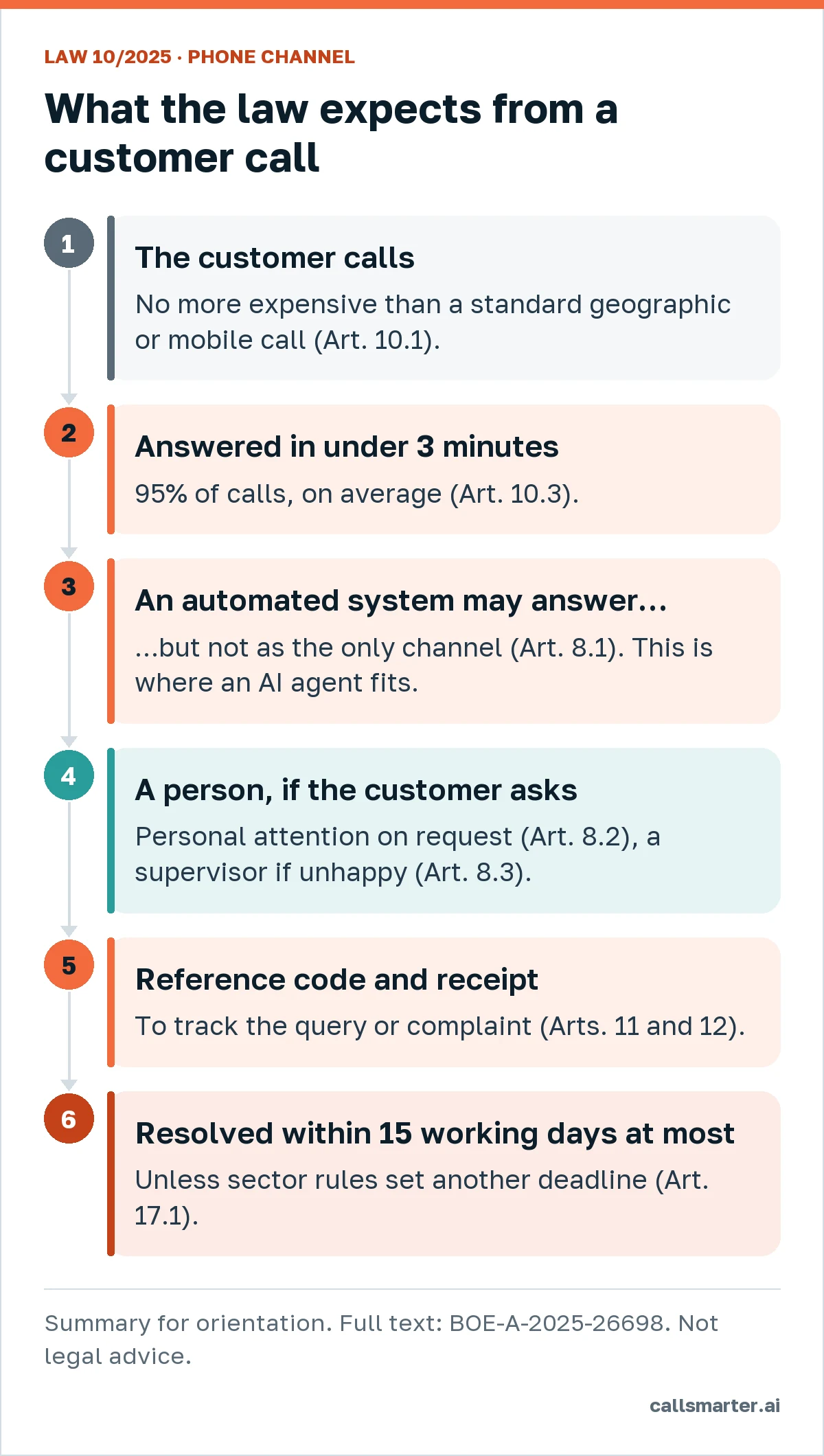
| Requirement | Article | In practice |
|---|---|---|
| Call cost | 10.1–10.2 | No more expensive than a call to a standard geographic or mobile number; if a premium line is used, also offer a geographic or mobile number |
| Waiting time | 10.3 | 95% of calls answered, on average, in under 3 minutes |
| No hang-ups for waiting | 8.4 | A call can't be cut because the wait is long |
| Automated, not exclusive | 8.1 | Automated answering systems can't be the only means of service |
| A person on request | 8.2 | On request, personal attention from the options in the phone channel's main menu |
| Supervisor | 8.3 | An unhappy customer can ask to be passed to a supervisor or quality department |
| Co-official languages | 8.6 | In regions with several official languages, service in the one the customer requests |
| Accessibility | 10.5 | For deaf customers, an accessible channel plus written messaging or sign-language video interpreting |
| Reference code | 11 | Every query, complaint or incident gets a code to track it |
| Receipt | 12 | On request, a receipt with content, date and time |
| Keep sales separate | 16 | Customer service on a number distinct from marketing; no selling on the back of service incidents |
| Resolution deadline | 17.1 | As soon as possible, within 15 working days at most, unless sector rules differ |
Article 16 is also the origin of Spain's 400 prefix for marketing calls, mandatory from 17 October 2026 — see Spain's 400 prefix explained.
Can AI handle customer service under the law?
Yes, with one clear condition: AI can't be the only path. The law bans automated answering systems as the exclusive means of service (Art. 8.1) and guarantees a person on request (Art. 8.2). The preamble itself mentions the possibility of using AI systems to facilitate communication between the parties.
In practice, an AI voice agent helps with what's hardest to meet and leaves people what the law reserves for them:
| Where AI helps | What stays human |
|---|---|
| Answering instantly, even at peaks: several calls at once, no queue | Personal attention when the customer asks |
| Resolving frequent questions from the knowledge base | Complaints that need judgement or compensation |
| Logging each query with category, urgency, date, time and transcript | The supervisor or quality department (Art. 8.3) |
| Alerting the team immediately to meet deadlines | The final decision and response to a complaint |
One more rule that comes from EU law rather than Law 10/2025: Article 50 of the AI Act requires people to be told they're talking to an AI system, unless obvious, from 2 August 2026. See our GDPR and AI Act guide.
How CallSmarter fits
- The agent says it's an AI and that the call is recorded in its first sentence; this can't be switched off.
- Several calls at once within your plan — no queue for lack of staff.
- If the customer asks for a person, the request is logged as a priority callback and your team is alerted immediately; where configured, the call can be transferred to an employee.
- Every request lands in the CRM with category, urgency, date, time, summary and transcript — a basis for the reference code and receipt.
- Recordings and a quality score for every call support your annual evaluation.
What CallSmarter doesn't do for you: design your complaints process, meet your resolution deadlines or guarantee compliance with the whole law. That depends on your organisation and your adviser. And to be precise: CallSmarter's AI reception currently answers through a “Call the AI” button on your website; phone-number answering is in preparation. For the step-by-step flow of an AI-answered call, read the AI phone answering service guide.
Checklist for your phone service
- Is your company within Article 2? Document it.
- Does your service number cost no more than a standard call?
- Do you measure answer times and reach 95% under 3 minutes?
- Can customers ask for a person from the main menu options?
- Is there a supervisor or quality department for unhappy customers?
- Do you give a reference code and, on request, a receipt?
- Do you resolve complaints within 15 working days?
- Do you serve in the co-official language requested, and accessibly?
- Are your service and marketing (400) numbers separate?
- Are the annual evaluation and audit planned?
Try it
To hear how an AI agent introduces itself and offers a person, talk to Foxy in your browser or let Foxy call you now. Running a contact centre? The contact-centre calculator estimates capacity with your own inputs. For the business case, read voice AI for business.
Frequently asked questions
What is Spain's Law 10/2025?
Law 10/2025 of 26 December regulating customer service (often called the “Ley SAC”). It sets minimum quality standards for customer service to consumers in Spain: waiting times, access to a person, response deadlines, accessibility and annual evaluation.
Who must comply?
All providers of basic services (water, gas, electricity, passenger transport, postal, electronic communications and financial services) and large companies selling to consumers, under the thresholds in its Article 2 — whether established in Spain or elsewhere. They have 12 months from entry into force on 28 December 2025 to adapt.
Does the law ban AI customer service?
No. It bans automated answering systems as the only means of customer service (Art. 8.1) and requires personal attention by a person on request (Art. 8.2). Its preamble even mentions AI systems as a way to support communication. An AI agent with a route to a person fits; one without it does not.
How long can a customer be kept waiting?
95% of calls must be answered, on average, within three minutes (Art. 10.3), and companies may not cut a call because of long waiting times (Art. 8.4).
How fast must complaints be resolved?
As quickly as possible and within 15 working days at most, unless sector rules set a different deadline (Art. 17.1).
Sources
- Spanish Law 10/2025 of 26 December regulating customer service (BOE-A-2025-26698, Spanish)
- Resolution of 14 April 2026 on 400 numbering for marketing calls (BOE-A-2026-8409, Spanish)
- Regulation (EU) 2024/1689, the AI Act (BOE / DOUE)
- European Commission: transparency obligations under Article 50 of the AI Act