
AI phone answering service: how it works and what to check
How an AI phone answering service handles your calls, how it compares with voicemail, IVR and human answering services, what it costs and what to ask.

An AI phone answering service puts a voice agent on your line: when a customer calls, the AI answers in your company's name, says it is an AI, handles common questions from your own information, takes down what your team needs and sends it on — logged, summarised and ready for a person to act on. It answers every call, including the third one at the same time, at 2 a.m. and on public holidays.
This guide explains how such a service works on a real call, how it compares with the alternatives (voicemail, phone menus, human answering services), what it costs and which questions separate a useful service from a demo that sounds good.
How an AI answering service handles a call
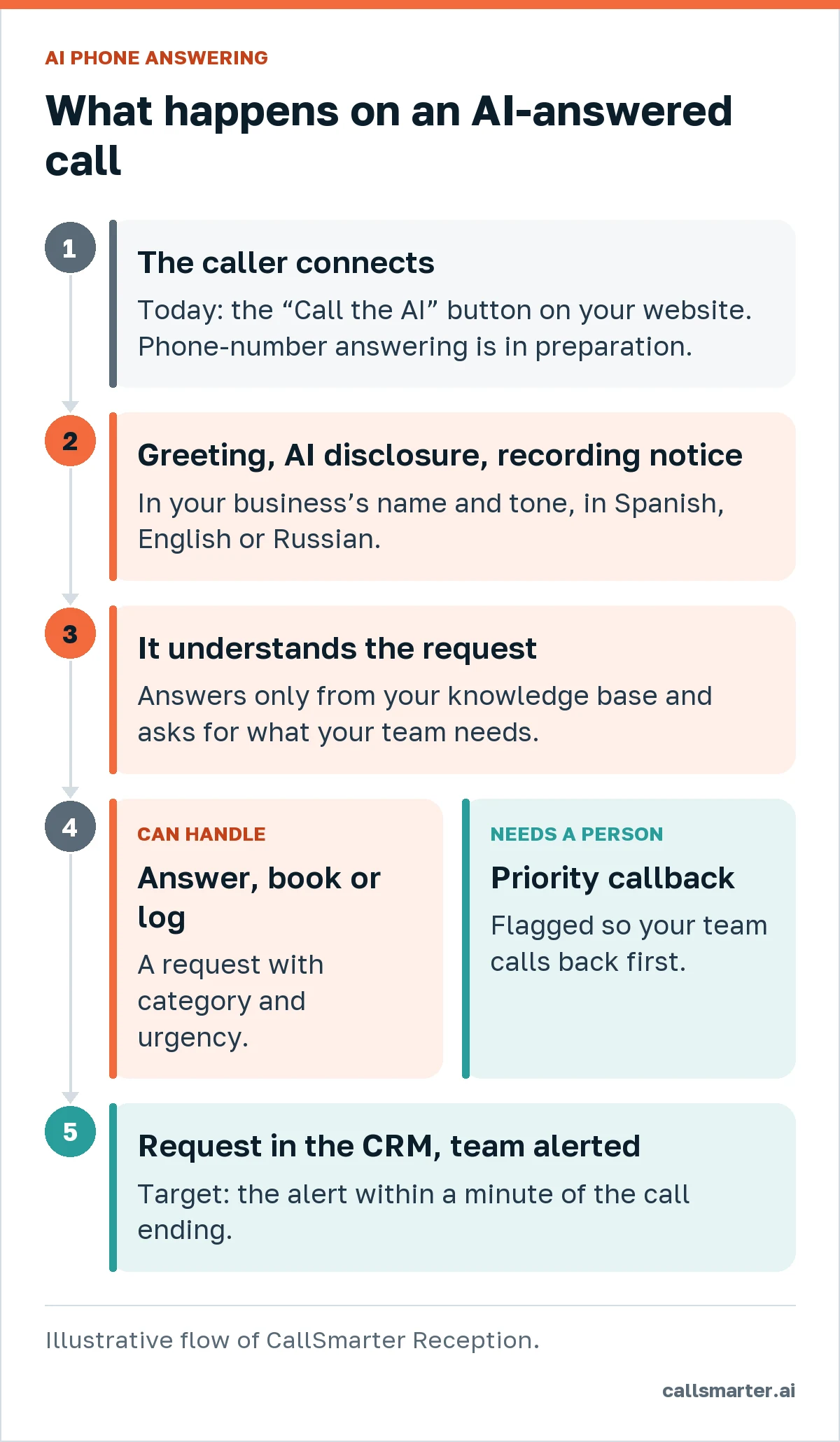
A well-built service follows the same five steps on every call.
- Connect. The caller reaches the AI line. With CallSmarter today this is a “Call the AI” button on your website; answering on a phone number is in preparation.
- Greet and disclose. In your business's name and tone: “Hello, I'm the AI assistant at the clinic. This call is recorded. How can I help?”
- Understand. The agent listens to the request in the caller's own words — no “press 1 for…” — and answers only from your knowledge base: hours, services, prices from your list, location, what to bring.
- Resolve or escalate. If it can handle it, it books or logs the request with category and urgency. If the caller needs a person, or the agent doesn't know, it says so and flags a priority callback.
- Hand over. The request lands in the CRM with summary and transcript, and your team gets a notification by Telegram, email, webhook or task. Our target is under a minute from the end of the call.
AI vs voicemail, phone menus and human answering services
Each option has its place. The honest comparison:
| Voicemail | Phone menu (IVR) | Human answering service | AI answering service | |
|---|---|---|---|---|
| Answers instantly, 24/7 | Records only | Yes, but menus only | Depends on contract and staffing | Yes |
| Several calls at once | — | Yes | Depends on staff | Yes, within your plan |
| Understands natural speech | No | Limited | Yes | Yes |
| Answers from your information | No | Pre-recorded | Within a script | From your knowledge base |
| Request logged with transcript | No | No | Usually a message | Automatically, with summary |
| Handles complex, emotional calls | No | No | Yes | Flags them for a person |
The key difference with a human answering service is not that the AI is “better” — a good receptionist is better at empathy and judgement. It's that the AI answers every call immediately and leaves a structured record of each one, so nothing depends on someone remembering to pass on a message. For a three-way comparison with an in-house receptionist and a phone system, see AI vs human receptionist vs phone system.
What an AI answering service is good at — and what it shouldn't do
Good at:
- FAQs that eat your team's time: opening hours, location, parking, what's included, how to book.
- Taking requests completely: name, contact, the problem, urgency, preferred time.
- Booking and confirming appointments.
- Covering the gaps: after hours, lunch, holidays, the busy hour when everyone's on another line. We cover the night shift in our after-hours answering service guide.
Shouldn't do:
- Invent answers. If it's not in your knowledge base, the agent says it doesn't know and logs the question.
- Medical triage or emergencies. If life may be at risk, it tells the caller to ring the emergency number (112 in the EU).
- Take card numbers or passwords by voice.
- Pretend to be human. It always says it's an AI.
What to prepare before switching it on
An AI answering service is only as good as what you give it. Before the first real call, prepare:
- A knowledge base in plain language. Opening hours, services, prices from your list, area covered, cancellation policy, what to bring. Short, factual answers beat long brochures.
- The fields your team needs. For a clinic: name, phone, reason, preferred day. For a plumber: address, the problem, whether water is running now. The agent asks for exactly these.
- Categories and urgency. Three to six request categories and a short definition of “urgent”, so requests arrive sorted.
- Who gets notified, where. One channel per kind of request — Telegram for urgent, email or the CRM for the rest — and who owns callbacks.
- What the agent must never say. No medical advice, no discounts it can't guarantee, no promises about arrival times.
Then test it the way your customers will: call it, interrupt it, ask something it doesn't know, ask for a person. Read the transcripts and adjust the script. Most of the improvement in the first weeks comes from this loop, not from the technology.
What it costs
AI answering services are usually priced as a monthly plan plus usage. With CallSmarter (excluding VAT): AI reception from €149/month, with a one-off €290 setup, plus €0.35 per minute of conversation, billed per second with a 30-second minimum per answered call. Plans differ in agents, lines and simultaneous calls. See pricing.
To decide whether it pays off, don't start from the price — start from the calls you lose today. Our guide on the cost of a missed call gives a simple formula: calls × % unanswered × % that would become customers × average ticket.
Ten questions to ask any provider
- Does the agent say it's an AI at the start? Can anyone switch that off?
- Does it announce the recording?
- What exactly happens when it doesn't know the answer?
- How does a caller reach a person, and how fast is my team alerted?
- Where do requests go — your CRM, mine, email, Telegram, webhook?
- Can I listen to recordings and read transcripts of every call?
- Is there a quality review of calls, automatic or manual?
- Which languages, and can it switch if the caller does?
- Where is data stored, for how long, and is there a processor agreement?
- What's the price per minute, the minimum per call, and are unanswered calls charged?
Rules for answering calls with AI
- AI disclosure. In the EU, Article 50 of the AI Act requires people to be told they are interacting with an AI system, unless obvious, from 2 August 2026.
- Data protection. Recording and transcribing calls is processing of personal data: inform callers, keep recordings only as long as needed, and sign a processor agreement. More in our GDPR and AI Act guide.
- Customer service rules in Spain. If your company falls under Spain's Law 10/2025, an automated system can't be the only channel for customer service: a person must be available on request. Read Spain's customer service law explained.
Try it before you decide
The fastest way to judge an AI answering service is to call one. Talk to Foxy in your browser — she's our AI assistant — or let Foxy call you now and try to catch her out. If you want the business case first, read voice AI for business, and for small businesses in Spain specifically, our guide to the AI receptionist.
Frequently asked questions
What is an AI phone answering service?
A service where an AI voice agent answers your customers' calls in your company's name: it greets them, says it is an AI, answers common questions from your information, takes the details of the request and sends it to your team.
How is it different from a human answering service?
A human service gives you people, usually with limited scripts and per-call or per-minute pricing. An AI service answers every call at once, 24/7, logs each request in the CRM with a transcript, and costs per minute of conversation. For complex, emotional or sensitive calls, a person is still better — the AI should flag those for a callback.
Can the AI answer my existing phone number?
With CallSmarter, the AI line works today through a “Call the AI” button on your website; answering on a phone number is in preparation. Ask us about your case during the pilot.
What if the caller wants a human?
The agent says it will pass the request on, logs it as a priority callback and your team is notified immediately.
Is it legal to record and transcribe the calls?
Yes, if callers are informed and you have a lawful basis and a processor agreement with the provider. CallSmarter's agent announces both the AI and the recording at the start; recordings are kept for 90 days by default.