
Voice AI for business: what it does and where it pays off
Voice AI for business, explained without hype: what an AI voice agent handles on inbound and outbound calls, what it costs, the rules, and how to start.

Voice AI for business means software that talks to your customers on the phone or through your website, in natural speech, and turns each conversation into something your team can act on: a booked appointment, a qualified request, a callback, a "not interested, don't call again". It is not a phone menu and it is not a chatbot reading text aloud. A good voice agent listens, understands, answers from your own information, can be interrupted, and knows when to hand over to a person.
This guide is for owners and managers deciding whether voice AI makes sense for them. It covers what it actually does, where it pays off, where it doesn't, what it costs, the rules you need to respect, and how to start without betting the business on it.
What voice AI does for a business
Almost every use falls into two families.
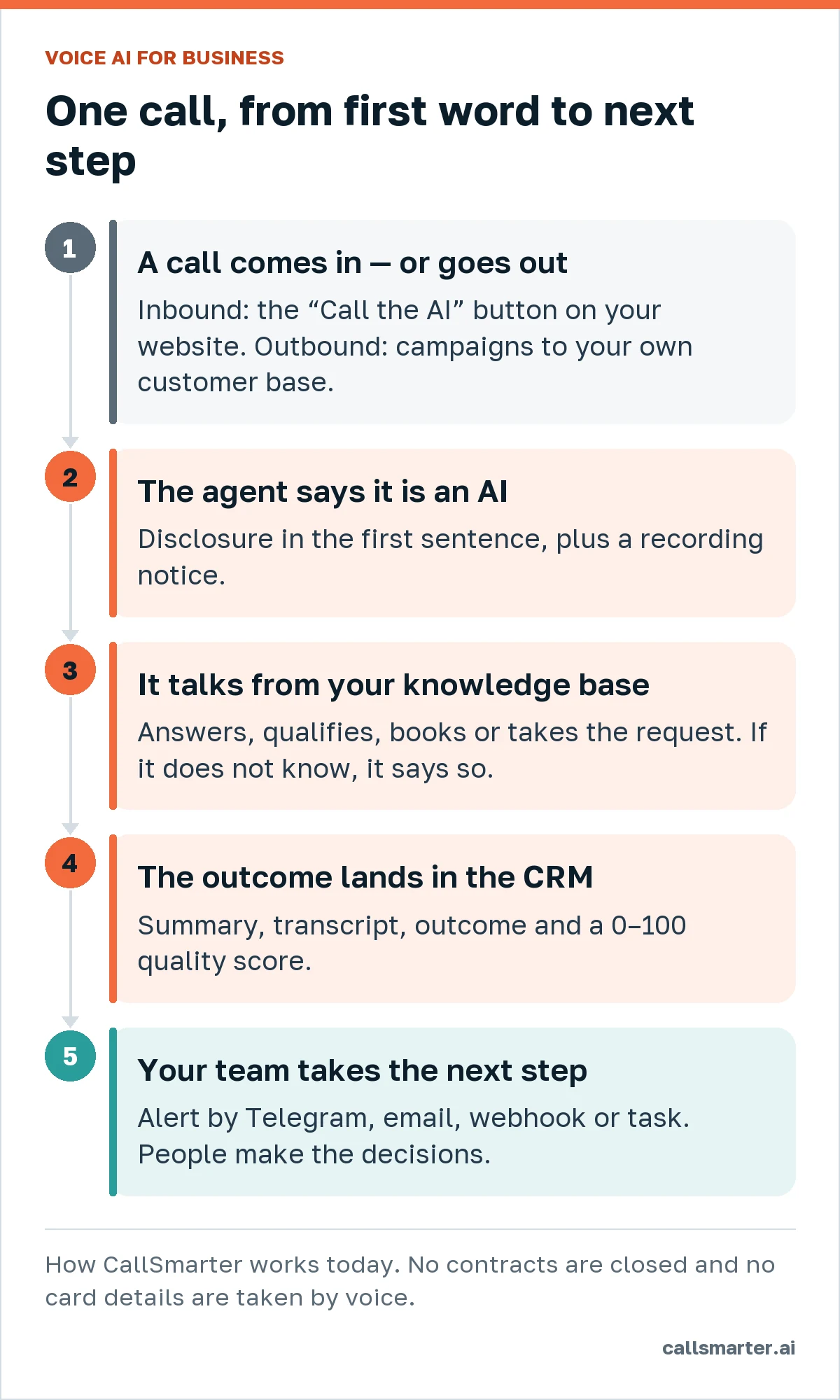
Inbound: answering. Customers call you, or press "Call the AI" on your website. The agent greets them in your company's name, says it is an AI, answers frequently asked questions from your knowledge base, collects what your team needs (name, contact, the problem, urgency) and books or logs the request. Typical moments: after hours, weekends, lunch, when the line is busy, during seasonal peaks. We cover this in detail in our guides to the AI phone answering service and the after-hours answering service.
Outbound: calling. The agent calls people on lists you are allowed to call: confirming tomorrow's appointment, following up a quote, reminding a contract customer that a service is due, or reactivating an old customer base that has given consent. Your team then speaks only to the people who are interested. See AI cold calling done right for the legal side of reactivation.
Both families share the same core: one conversation, one outcome, one record.
Where voice AI pays off — and where it doesn't
Voice AI is not magic and it is not for every call. A simple test: is the conversation repetitive, structured and low-risk, and does it end in a clear next step? If yes, it's a candidate.
| Good fit | Poor fit |
|---|---|
| Answering FAQs: hours, prices from your list, location, what to bring | Negotiating prices or contract terms |
| Taking a request with name, contact, need and urgency | Complaints that need judgement and goodwill |
| Booking or confirming appointments | Medical triage, emergencies (the agent says: call 112) |
| Following up quotes a customer asked for | Collecting card numbers or passwords by voice |
| Calling a consented list to ask if they want an adviser to call | Calling bought lists or random numbers |
The value usually comes from three places:
- Calls that would otherwise be lost. If a share of calls goes unanswered, each one is a potential customer who rings the next business on the list. Our guide on the cost of a missed call shows how to estimate this for your own numbers rather than trusting someone else's statistics.
- Hours your team stops spending on repetitive calls. 800 contacts × 3 minutes per first call is 40 hours of dialling — before retries.
- Speed. A request logged and sent to your team a minute after the call ends is worth more than a voicemail heard the next morning.
What voice AI should not be sold as: a replacement for good people. It covers the gaps — night, peaks, repetitive work — so that people spend their time where judgement matters.
How a voice AI agent works, briefly
Under the hood, a modern agent uses a real-time speech model: it hears the caller, reasons with your instructions and knowledge base, and speaks back within the same conversation. It can use tools — book a slot, log a request, set the call outcome, mark "do not call", hand over to a person. After the call you get the recording, transcript, a summary and, on CallSmarter, an automatic quality score from 0 to 100. For a deeper look, read what an AI voice agent is and how it works and our step-by-step guide on how to build one.
What voice AI costs
Pricing in this market usually combines a monthly plan with usage. Look at three things:
- Monthly plan. What's included: agents, lines, simultaneous calls, CRM, integrations.
- Per-minute or per-call usage. Per-minute is more transparent for long and short calls alike; check the minimum billed per call and whether unanswered calls cost anything.
- Setup. Who writes the script and the knowledge base, and is it a one-off fee?
For reference, CallSmarter's public prices (excluding VAT): AI reception from €149/month with a one-off €290 setup; outbound campaigns from €199/month; every minute of conversation €0.35, billed per second with a 30-second minimum per answered call; unanswered calls are free. Full details on the pricing section. If you run a call centre, the contact-centre calculator estimates capacity and revenue with your own inputs.
Rules you can't skip
Voice AI is regulated like any other way of contacting customers, plus a few AI-specific points.
- Say it's an AI. Article 50 of the EU AI Act, applicable from 2 August 2026, requires people to be informed that they are interacting with an AI system, unless it is obvious. With CallSmarter the disclosure is part of the platform and can't be removed by a script.
- Recording and data protection. If calls are recorded, people must be told. You are the data controller; the provider is a processor under a data processing agreement. More in our GDPR and AI Act guide.
- Outbound has its own rules. In Spain, Article 66 of the General Telecommunications Act restricts marketing calls; automated calls without human intervention need prior consent. In the US and UK, rules on artificial voices and marketing calls are also strict. Never call bought lists.
- Customer service quality (Spain). Large companies and basic-service providers are subject to Law 10/2025: an automated system can't be the only channel and a person must be available on request. See our guide to Spain's customer service law.
None of this is legal advice; check your case with your adviser.
How to choose a provider
Ask every vendor the same questions:
- Does the agent always disclose it's an AI? Can a customer script switch that off?
- What happens when it doesn't know? It should say so and log the question, not invent.
- How do requests reach my team? CRM record, email, Telegram, webhook, tasks — and how fast.
- Can I hear and read every call? Recordings, transcripts, summaries, quality review.
- What does a "no" do? Opt-outs must be recorded once and respected everywhere.
- Where does the data live, and for how long? Retention of recordings, processor agreement.
- What's the real price per minute, and what's the minimum per call?
Start small: a 4-week pilot
The safest way in is a pilot with one measurable goal. We typically run about four weeks and 500–1,000 calls: define, prepare, go live, evaluate.
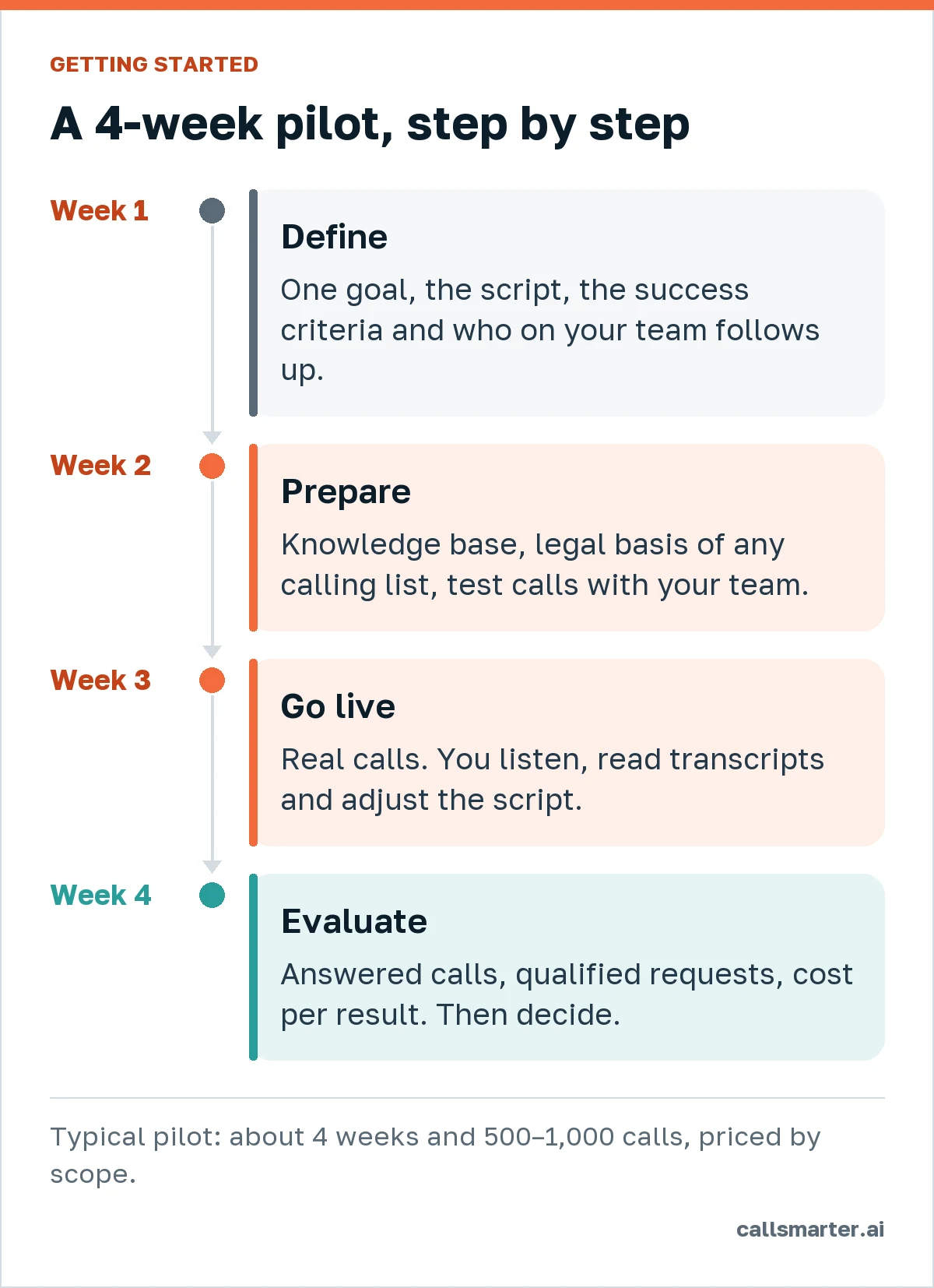
At the end you have real numbers — answered calls, qualified requests, cost per result — instead of a vendor's promise. We also run our own sales on the same platform; you can see how in CallSmarter on CallSmarter.
Want to hear it first? Let Foxy call you now — she's our AI assistant, and she'll tell you she's an AI in her first sentence. Or talk to her in your browser. When you're ready, request a pilot.
Frequently asked questions
What is voice AI for business?
Software that holds real phone or web voice conversations on behalf of a company: it answers questions, takes requests, books appointments or calls customers, and hands the result to the team. It is not an IVR menu: the caller speaks normally and can interrupt.
Will customers know they are talking to an AI?
They should, and with CallSmarter they always do: the agent says it is an AI in its first sentence. In the EU, Article 50 of the AI Act requires this from 2 August 2026, unless it is obvious.
How much does voice AI cost?
Usually a monthly plan plus usage. CallSmarter's AI reception starts at €149/month and outbound campaigns at €199/month, plus €0.35 per minute of conversation, excluding VAT. Unanswered calls are not charged.
Does voice AI replace my staff?
No. It covers the hours and peaks when nobody can answer and the repetitive calls nobody wants to make. Decisions, negotiations and anything sensitive stay with people.
Which languages does it speak?
CallSmarter agents work in Spanish, English, Russian, Catalan, Portuguese, French, German, Italian and Hebrew; language and tone are set per agent.