
What is an AI voice agent? How it works and where it's used
What an AI voice agent is, how it works under the hood, use cases by industry, how to choose one and the EU rules that apply. A plain-English guide.

An AI voice agent is an artificial intelligence system that talks — on the phone or from a website — on behalf of a business, in real time and in natural language. It understands what callers say, answers from the information you've given it, and does things: books an appointment, logs a request, records the outcome of the call, notes that someone doesn't want to be called again, or hands the conversation to a person. Unlike a phone menu, nobody has to press keys; unlike a chatbot, it speaks.
This guide covers what an AI voice agent is, how it works under the hood, what it's used for by industry, how to choose one, and which rules apply in the EU (and, briefly, the US). For a step-by-step setup guide, see how to build an AI voice agent.
What an AI voice agent is — and isn't
| Phone menu (IVR) | Chatbot | AI voice agent | |
|---|---|---|---|
| Channel | Phone | Text (web, messaging) | Voice: phone or web |
| How you talk to it | Keys or exact words | Typing | Normal sentences, interrupting if needed |
| What it does | Routes the call | Replies in writing | Converses, answers and takes actions |
| Result | A queue | A text conversation | A recorded outcome: booking, request, callback, “do not call” |
An AI voice agent is not a person and shouldn't pretend to be one. Nor is it an oracle: it answers from what you give it and should say “I don't know” when it doesn't.
How it works under the hood
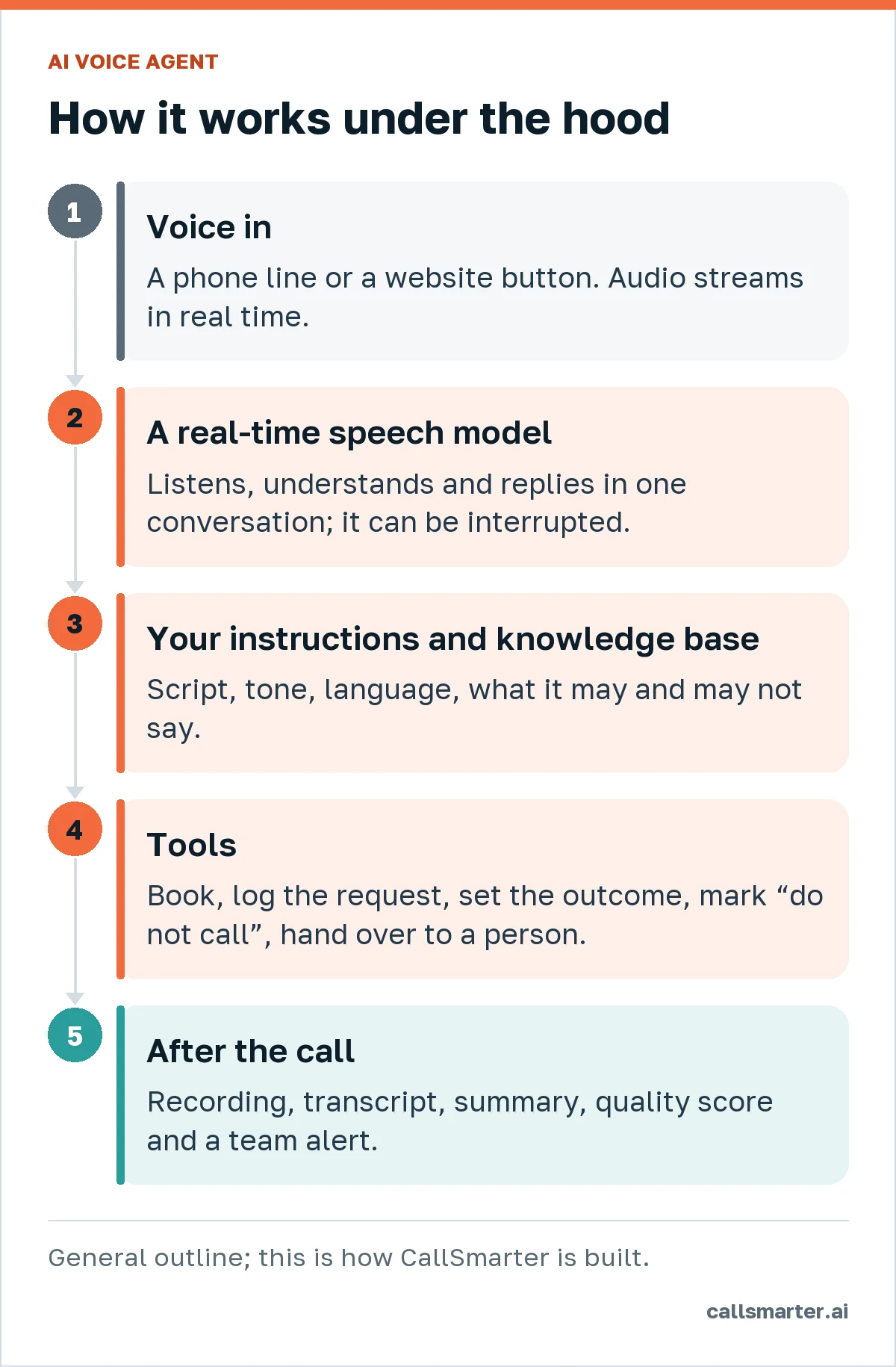
- Voice in. Audio streams in real time from a phone line or a website button.
- A real-time speech model. Current systems listen and reply within the same conversation, instead of the older slow chain of “transcribe, think, synthesise”. That's why you can interrupt them and replies come almost immediately.
- Instructions and knowledge base. The script sets the goal, tone, language and limits; the knowledge base holds your facts: hours, services, prices from your list, policies.
- Tools. Actions the agent can take during the call: book a slot, log a request with category and urgency, set the outcome, mark “do not call”, hand over to a person.
- After the call. Recording, transcript, summary, a quality score (on CallSmarter, from 0 to 100) and a team alert by Telegram, email, webhook or task.
Use cases by industry
Illustrative scenarios, not customer cases:
| Industry | Inbound calls | Outbound calls |
|---|---|---|
| Dental clinics | Appointments, after-hours urgent cases (with advice to call 112 if at risk) | Confirming tomorrow's appointments |
| Home services | Breakdown calls, qualifying urgency and area | Following up quotes customers asked for |
| Real estate and holiday rentals | Property enquiries in several languages | Calling back people who asked for information |
| Restaurants | Bookings and questions at peak times | Confirming group bookings |
| B2B sales | Handling demo requests | Calling form leads within minutes |
| Contract customers | Billing questions and admin | Service and renewal reminders |
More detail in our guides for dental clinics, home services and restaurants. For calling your own customer base, read AI cold calling done right; for answering, the AI phone answering service guide.
How to choose an AI voice agent
Always test by calling it yourself, then compare:
- Naturalness and latency. Can you interrupt it? Does it reply without long silences?
- Faithfulness. Does it answer only from your knowledge base? What does it do when it doesn't know?
- Transparency. Does it always say it's an AI? Does it mention recording?
- Escalation. How does a caller reach a person, and what happens then?
- Integration. Where do outcomes go: a built-in CRM, yours via webhook, email, Telegram, calendar?
- Control. Recordings, transcripts, summaries, quality review, script versions and A/B tests.
- Languages. The ones your customers speak. CallSmarter agents currently work in Spanish, English, Russian, Catalan, Portuguese, French, German, Italian and Hebrew.
- Data. Where it's stored, for how long (on CallSmarter, recordings 90 days by default), and a processor agreement.
- Real price. Plan, per-minute rate, minimum per call, unanswered calls, setup.
Common mistakes when rolling out a voice agent
- Asking it to do everything on day one. Start with one goal — after-hours calls, appointment confirmations, or calling new form leads — and expand once it works.
- A brochure for a knowledge base. Long, generic text produces vague answers. Short questions and answers with concrete facts work better.
- No definition of “urgent” and no owner for alerts. If the alert lands in an inbox nobody reads, the AI answered for nothing.
- Hiding that it's an AI. Besides breaking the rules, it destroys trust when the caller notices. Say it in the first sentence.
- Not listening to calls. In the first weeks, read transcripts daily: that's where you find the questions missing from the knowledge base.
- Calling lists you can't use. For outbound, the legal basis of each list comes before the script.
Rules that apply
- Transparency (EU AI Act, Art. 50). From 2 August 2026, people talking to an AI must be told, unless obvious.
- Data protection (GDPR). Recording and transcribing is personal data processing: inform people, have a legal basis, limit retention, sign a processor agreement. More in our GDPR and AI Act guide.
- Outbound calls. In Spain, automated marketing calls without human intervention need prior consent (Art. 66 of the Telecommunications Act), and from 17 October 2026 companies under Law 10/2025 must use 400 numbers for marketing (Spain's 400 prefix). In the US, the FCC ruled in 2024 that AI-generated voices are “artificial” voices under the TCPA, so prior express consent is required.
- Customer service in Spain (Law 10/2025). For companies in scope, an automated system can't be the only channel, and a person must be available on request (Spain's customer service law).
What it costs
With CallSmarter (excluding VAT): AI reception from €149/month plus a one-off €290 setup; outbound campaigns from €199/month; €0.35 per minute of conversation, billed per second with a 30-second minimum per answered call; unanswered calls are free. See pricing, and for the full business case, voice AI for business.
Hear one before you decide
Nothing explains an AI voice agent like talking to one. Talk to Foxy in your browser — she's our AI assistant — or let Foxy call you now with a scenario from your industry. To see how we use voice agents to sell our own product, visit CallSmarter on CallSmarter.
Frequently asked questions
What is an AI voice agent?
An AI system that holds real-time voice conversations — by phone or from a website — on behalf of a business: it understands what people say, answers from the information it's been given and takes actions such as booking an appointment or logging a request.
How is it different from an IVR or a chatbot?
An IVR makes you press keys or say exact words and only routes calls. A chatbot is text. An AI voice agent talks in natural language, can be interrupted and ends the call with a recorded outcome.
Can it make mistakes?
Yes, like any system. That's why it should answer only from its knowledge base, say when it doesn't know, hand sensitive cases to a person, and leave a recording and transcript so every call can be reviewed.
Does it have to say it's an AI?
In the EU, Article 50 of the AI Act requires people to be told they are interacting with an AI system, unless obvious, from 2 August 2026. CallSmarter agents always say so in their first sentence.
How much does an AI voice agent cost?
It depends on the provider. With CallSmarter: AI reception from €149/month, outbound campaigns from €199/month, plus €0.35 per minute of conversation, excluding VAT. Unanswered calls are not charged.
Sources
- Regulation (EU) 2024/1689, the AI Act (BOE / DOUE)
- European Commission: transparency obligations under Article 50 of the AI Act
- AEPD: GDPR compliance of processing that embeds artificial intelligence (guide, Spanish)
- FCC Declaratory Ruling FCC 24-17: AI-generated voices under the TCPA
- Spanish Law 11/2022, General Telecommunications Act, Article 66 (BOE)